Solar Urticaria Window Tint Exemption
 by Areeba Imran
Last updated:
Medically reviewed by:
Dr. Matthew Reynolds, MD


Are you or someone you know allergic to the sun? Solar urticaria is a rare type of urticaria. Sunlight or certain light wavelengths trigger itchy, red welts on the skin within minutes of exposure. It is a rather painful condition. It often makes people find it hard to do everyday work.
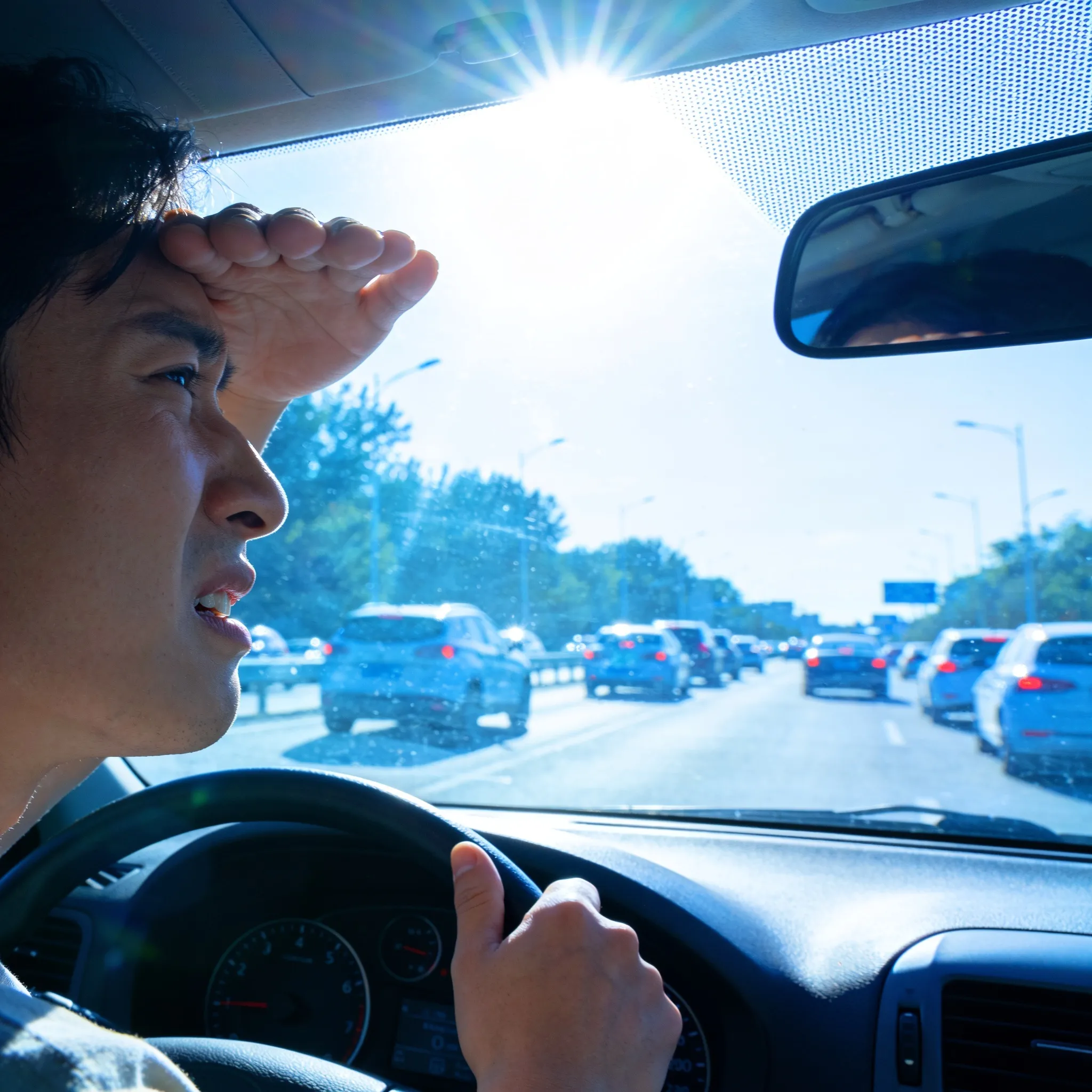
Driving is a very difficult task because of sun exposure and continuous time on the road. This is one of the many qualifying conditions in most U.S. states for medical window tint exemption. While many require additional paperwork for a tint exemption.
Solar urticaria can make everyday activities difficult, especially during driving or travel in sunlight. This guide explains what solar urticaria is, what causes it, how doctors diagnose and treat it, and when a medical window tint exemption may be considered.
A window tint medical exemption may be available if a licensed physician determines medical necessity. Eligibility varies by state.
What Causes Solar Urticaria?
Solar urticaria occurs when exposure to sunlight or another triggering light source causes an abnormal reaction in the skin. The exact mechanism is unclear. Researchers believe light activates a photoallergen or photoactive substance. This triggers mast-cell activation and histamine release.
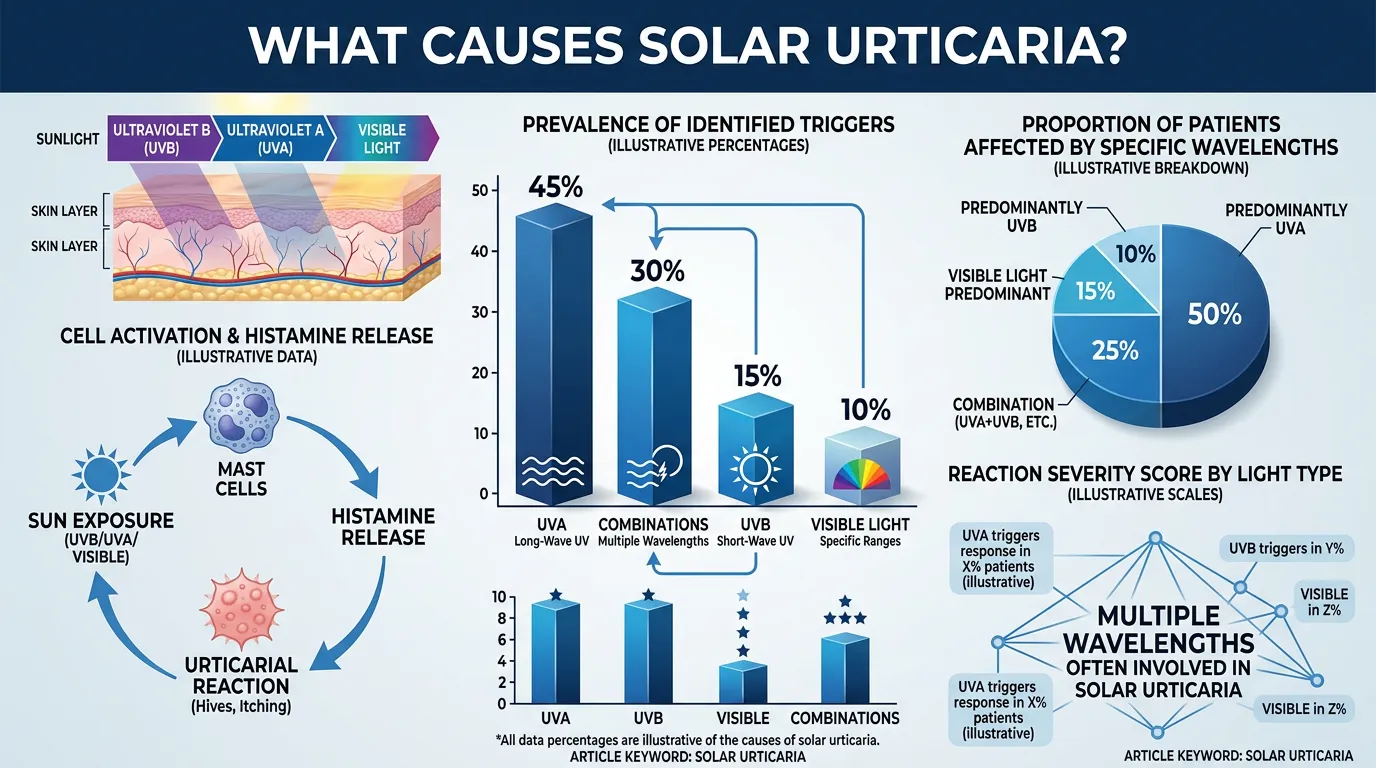
This immune response produces the rapid redness, swelling, and itching characteristic of solar urticaria.
The specific wavelengths that trigger the condition vary from person to person. The action spectrum ranges from ultraviolet light into visible light. Identifying the individual’s trigger is needed when planning treatment and photoprotection.
Which Types of Light Can Trigger Solar Urticaria?
Solar urticaria can be triggered by different wavelengths depending on the individual.
Possible triggers include:
-
Ultraviolet B (UVB)
-
Ultraviolet A (UVA)
-
Visible light
-
Combinations of different wavelengths
The action spectrum is patient-specific. Phototesting can help determine which wavelengths provoke a reaction.
Visible light can damage skin. Regular sunscreen may not block all visible wavelengths. Your dermatologist can recommend appropriate photoprotection based on your specific sensitivity.
Solar Urticaria Symptoms
Solar urticaria usually develops rapidly after exposure to triggering light. The most common symptoms affect the skin directly exposed to the light.
Skin Symptoms
Common symptoms include:
-
Red or pink raised welts called wheals
-
Intense itching
-
Burning or stinging
-
Localized swelling
-
Redness around the affected area
Solar urticaria typically affects exposed skin. However, covered areas may also react if enough light passes through the fabric.
Symptoms can occur on the:
-
Face and neck
-
Arms and hands
-
Chest and shoulders
-
Other areas exposed to sunlight or artificial UV light
The appearance and severity vary between people. Some reactions are limited to small areas, while others can involve larger areas of skin.
How Quickly Do Solar Urticaria Symptoms Appear?
Solar urticaria characteristically develops within minutes of exposure. In some cases, symptoms can occur very rapidly after exposure.
Once exposure stops, the reaction usually begins to resolve within minutes to a few hours. Rarely, symptoms can persist for longer, including up to 24 hours.
Solar urticaria appears and clears quickly, which helps doctors tell it apart from other photosensitivity disorders.
Can Solar Urticaria Cause Symptoms Beyond the Skin?
Extensive reactions can sometimes cause systemic symptoms.
These may include:
-
Headache
-
Light-headedness
-
Dizziness
-
Nausea
-
Vomiting
-
Wheezing or breathing difficulty
Systemic symptoms can be serious. Seek urgent medical attention if you develop breathing difficulty, significant swelling, fainting, or other signs of a severe allergic reaction.
How Is Solar Urticaria Diagnosed?
Diagnosis begins with a detailed medical history and examination. Your doctor will ask when symptoms appear, how long they last, which areas of skin are affected, and what type of light appears to trigger them.
Because several photosensitivity disorders can cause similar symptoms, an accurate diagnosis matters.
Medical History and Symptom Pattern
Your physician may review:

-
How quickly the reaction develops after light exposure
-
Which parts of the body are affected
-
How long the reaction lasts
-
Whether clothing prevents or reduces the reaction
-
Whether medications or other conditions could be contributing to photosensitivity
The rapid appearance of wheals after light exposure is an important clinical feature.
Phototesting
Phototesting can confirm solar urticaria and identify which wavelengths trigger the reaction.
During testing, controlled doses of specific wavelengths of light are applied to small areas of skin. Testing may include UVA, UVB, and visible wavelengths depending on the suspected action spectrum.
Your dermatologist can use the results to identify which wavelengths trigger your symptoms and create a photoprotection plan for you.
Ruling Out Other Photosensitivity Conditions
Solar urticaria can resemble other photosensitive conditions, including:
-
Polymorphic light eruption
-
Drug-induced photosensitivity
-
Chronic actinic dermatitis
-
Porphyrias
-
Other forms of photosensitivity
Your physician may use additional laboratory testing or other investigations when another condition needs to be excluded.
Self-diagnosis is not recommended because treatment depends on the underlying cause of the reaction.
How Is Solar Urticaria Treated and Managed?
Treatment focuses on minimizing exposure to triggering light and controlling symptoms.
Your dermatologist will choose treatment based on the severity of your reactions and your individual trigger wavelengths.
Reducing Sun Exposure
Avoiding or minimizing exposure to triggering light is a core part of management.
Helpful measures may include:
-
Seeking shade when sunlight is strongest
-
Wearing tightly woven, sun-protective clothing
-
Using appropriate sunscreen
-
Wearing a wide-brimmed hat and other protective accessories
-
Limiting exposure when possible
-
Using appropriate UV-blocking window films or other environmental protection when recommended
The best protection depends on the wavelengths that trigger your solar urticaria.
Medications and Other Medical Treatments
Doctors often prescribe second-generation H1 antihistamines as the first treatment for urticaria. Common options include cetirizine, fexofenadine, and loratadine.
They may reduce itching and whealing, although they do not completely prevent reactions in every person with solar urticaria.
For people who do not respond adequately to antihistamines and photoprotection, a dermatologist may consider additional treatments.
Omalizumab has been studied in patients with difficult-to-control solar urticaria and may be considered for selected refractory cases.
Treatment decisions should be made with a qualified healthcare professional rather than based on an online guide.
Desensitization and Specialist Treatment
Phototherapy or photochemotherapy may be considered for selected patients. These approaches attempt to increase tolerance to the wavelengths that trigger the condition.
Desensitization can be temporary, so repeated treatment may sometimes be necessary.
Because controlled light exposure can also provoke symptoms, these treatments should be performed under appropriate medical supervision.
Can Window Tint Help With Solar Urticaria?
Window tint or appropriate window film may reduce the amount of triggering light reaching your skin while you are inside a vehicle.
However, its effectiveness depends on your specific action spectrum and the optical properties of the window and film.
Standard vehicle glass does not block all wavelengths equally. Some types of glass provide substantial UV protection, while the amount of UVA or visible light transmitted can vary by vehicle, glass type, and window.
Why the Type of Light Matters
Not everyone with solar urticaria reacts to the same wavelengths.
If your symptoms are triggered by UVA, for example, a film specifically designed to reduce UVA transmission may be more relevant than simply choosing the darkest tint.
The same principle applies to visible-light sensitivity.
Therefore, the darkest available tint is not automatically the most effective option. Your dermatologist can help identify your triggering wavelengths through appropriate testing, while a qualified window-film professional can provide information about the optical properties of a specific product.
Window tint is an environmental accommodation, not a cure for solar urticaria. It does not change the underlying immune response or prevent reactions when you are exposed to triggering light outside the vehicle.
When Might a Medical Window Tint Exemption Be Considered for Solar Urticaria?
A medical window tint exemption may be considered when a person’s medical condition requires additional protection from sunlight and standard protective measures are inadequate.
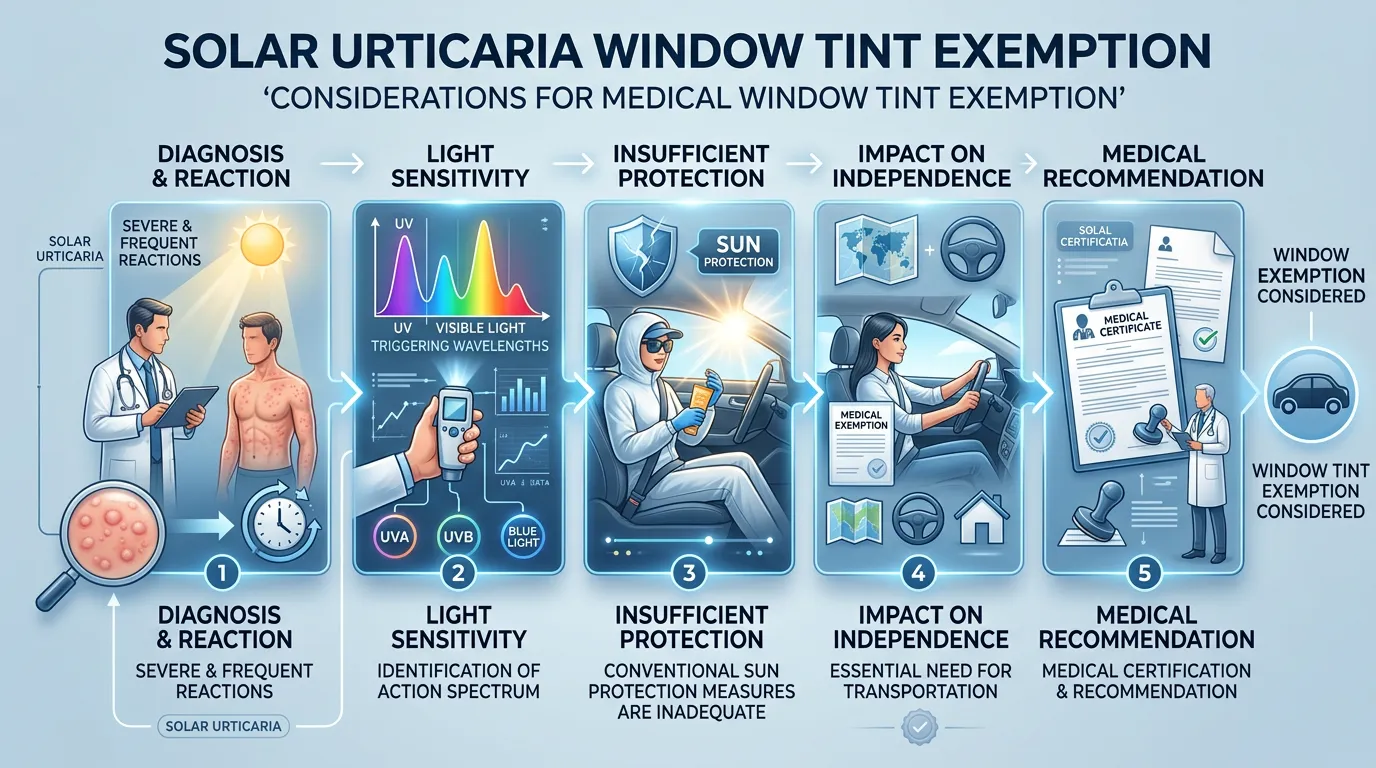
Having solar urticaria does not automatically guarantee an exemption.
Eligibility depends on the laws and procedures in the state where the vehicle is registered. A physician or other authorized healthcare professional may need to document the medical necessity according to the applicable state requirements.
Factors that may be relevant include:
-
The severity and frequency of light-triggered reactions
-
The wavelengths that trigger symptoms
-
Whether standard sun-protection measures provide adequate protection
-
The effect of the condition on necessary travel
-
Whether additional window protection is medically necessary
A diagnosis alone does not establish eligibility for every state’s exemption program.
What Medical Documentation May Be Required?
Medical documentation requirements vary by state. Depending on the jurisdiction, an application may require information such as:
-
A confirmed medical diagnosis
-
Description of symptoms and severity
-
Documentation of photosensitivity or triggering wavelengths when clinically established
-
A statement explaining the medical need for additional sunlight protection
-
Physician or other authorized healthcare provider information
-
Required state forms or certification
-
Vehicle or registration information
Some states require specific forms, while others allow a signed medical statement or certification.
Your healthcare provider should document your condition accurately. Do not exaggerate or coach symptoms to obtain an exemption. The medical professional must independently determine whether additional protection is medically necessary.
Some states also have specific rules regarding renewal, vehicle transfer, expiration, or the documentation that must be kept in the vehicle.
Solar Urticaria Window Tint Exemption Requirements by State
Medical window tint rules are state-specific and can change. Always verify the current requirements with the relevant state motor vehicle agency before installing tint based on a medical exemption.
Florida
Florida provides a formal sunscreening medical exemption process through the Florida Department of Highway Safety and Motor Vehicles.
The state uses Form HSMV 83390, Application for Sunscreening Medical Exemption. An original application requires the appropriate physician or other authorized healthcare professional to complete and sign the physician certification section.
The current Florida tint exemption form states that the medical exemption certificate has no expiration date and is non-transferable. It becomes invalid when the vehicle identified on the certificate is sold or transferred.
Check the current Florida form and requirements before applying.
Texas
Texas provides a medical exception for certain window-tint requirements.
According to the Texas Department of Public Safety, a motorist who needs darker tint on the front windows for medical reasons must obtain a signed medical exemption statement from a licensed physician or licensed optometrist.
The statement must identify the driver or occupant with reasonable specificity and state that the sunscreening device is necessary to safeguard that person’s health.
Texas no longer issues the former Window Tint Exemption Certificate. The signed medical statement serves as proof of the medical exception and must be kept in the vehicle and presented when required.
New York
New York has a formal Application for Tinted Window Exemption.
The New York DMV states that an exemption may be available for a person who, for medical reasons, must be shielded from direct sunlight when personal protective measures such as sun-protective clothing, sunscreen, eye protection, or clear UV-protective window film do not provide adequate protection.
The application requires medical certification and supporting documentation. Only medical conditions specified under the applicable New York rules qualify.
Because New York’s eligibility criteria are specific, review the current DMV application before applying.
Other States
Medical tint exemptions differ substantially across the United States. Some states have formal applications, while others use physician certifications or other documentation.
Do not assume that a diagnosis of solar urticaria automatically qualifies you for an exemption in your state.
Before applying, check:
-
Whether your state allows medical tint exemptions
-
Which medical conditions qualify
-
Who can complete the medical certification
-
What documentation is required
-
Which windows may be covered by the exemption
-
Whether the exemption expires or must be renewed
-
What documentation must be carried in the vehicle
How to Get a Window Tint Exemption for Solar Urticaria
Step 1: Review Your State’s Requirements
Check your state’s current medical window-tint rules before applying.
Confirm the eligibility criteria, required forms, permitted tint levels, and documentation requirements.
Step 2: Speak With a Licensed Healthcare Professional
Discuss your solar urticaria with your dermatologist, allergist, or other qualified healthcare professional.
Explain how light exposure affects your daily activities and whether exposure during necessary vehicle travel causes symptoms.
Your doctor can review your medical history and phototesting results, when available, and determine whether additional protection may be medically necessary.
Step 3: Complete the State Process
Complete the required state application or medical certification.
Submit the documentation through the process specified by your state’s motor vehicle agency.
If your exemption is approved, follow the state’s rules regarding installation, vehicle documentation, renewal, and carrying proof of the exemption.
Conclusion
Solar urticaria is a rare form of inducible urticaria that causes itchy, red wheals within minutes of exposure to triggering light. The condition can interfere with everyday activities and, in severe cases, may cause symptoms beyond the skin.
Diagnosis usually combines a detailed clinical history with phototesting to identify the wavelengths that trigger symptoms. Treatment focuses on minimizing exposure, protecting the skin, controlling symptoms with appropriate medication, and considering specialist treatments when necessary.
Window tint may provide an additional environmental layer of protection during vehicle travel, but it does not cure solar urticaria. Whether you qualify for a medical window tint exemption depends on your medical circumstances and the laws of your state.
If you develop hives after sunlight exposure, speak with a dermatologist or other qualified healthcare professional for proper evaluation. If your condition makes vehicle travel difficult, ask whether additional light protection may be medically appropriate for you.
Check your eligibility for medical window tints for your car without leaving home. Tinted MD can help guide patients through the medical evaluation and documentation process when a healthcare professional determines that additional window protection may be medically necessary.
Frequently Asked Questions
What triggers hives in people with solar urticaria?
Sunlight or specific wavelengths of UV or visible light trigger hives in solar urticaria. Your immune system treats light-altered skin proteins as threats. This causes mast cells to release histamine into surrounding tissue. The reaction happens within minutes of exposure. Different people react to different parts of the light spectrum. Some respond to UVA, others to UVB, and some to visible light. The exact compound that triggers this immune response remains unknown in most cases.
How quickly do symptoms appear after sun exposure?
Symptoms appear within minutes of light exposure. You'll notice raised, itchy welts on your skin almost immediately after stepping into sunlight. This quick reaction separates solar urticaria from ordinary sunburn, which develops over hours. The hives typically fade within 24 hours once you're out of the light. But repeated exposure brings them right back. Even light through car windows can trigger a reaction fast enough to make driving a medical challenge.
How rare is solar urticaria compared to other skin conditions?
Solar urticaria affects roughly 1 in 2,000 to 3,000 people. This makes it a rare photosensitive condition. It affects fewer than 1% of people with chronic hives. The condition is distinct from common sun allergies. Because it's so rare, many doctors have limited experience diagnosing and treating it. This rarity also means fewer people understand the daily challenges of living with the condition, including the need for accommodations like medical window tint exemptions.
Can light through car windows cause a solar urticaria reaction?
Yes, light through car windows can trigger solar urticaria reactions. Even indirect sunlight filtered through glass can cause painful hives within minutes. This makes a simple drive a medical challenge for people with this condition. The wavelengths that trigger reactions vary by person. Some people react to UVA, which passes through standard car windows. Others react to visible light, which also penetrates glass. This is why many people with solar urticaria seek medical window tint exemptions for their vehicles.
Does solar urticaria involve the same immune response as other allergies?
Solar urticaria involves a Type I hypersensitivity reaction, similar to other allergic conditions. Your immune system mistakes light-altered skin proteins for foreign invaders. This sets off a cascade of defensive reactions. Mast cells in your skin detect these changes and dump histamine into surrounding tissue. This causes the rapid swelling and redness you see. However, the exact photoallergen remains unknown in most cases, which makes treatment more challenging than other allergic conditions where the trigger is clear.
Why do different people react to different wavelengths of light?
Solar urticaria can involve UVA, UVB, or visible light wavelengths. Some people react to just one wavelength, while others react to combinations. This wavelength-specific nature makes testing necessary to identify your triggers. A doctor can determine which light causes your symptoms through phototesting. The severity also depends on exposure duration and intensity. Brief exposure might cause mild itching, while longer exposure can trigger widespread hives. Understanding your specific triggers helps you manage the condition better and guides treatment decisions.
How long do solar urticaria hives last after you leave the sun?
The hives typically fade within 24 hours once you're out of the light. This relatively quick resolution is characteristic of solar urticaria. However, repeated exposure brings the hives right back immediately. The welts appear within minutes of sun exposure and disappear within a day of avoiding light. This cycle can repeat daily for people who must go outside regularly. The temporary nature of each outbreak doesn't make the condition less serious, as the pain and discomfort during reactions can be severe.
What makes solar urticaria different from regular sunburn?
Solar urticaria causes raised, itchy welts within minutes of light exposure. Sunburn develops over hours, not minutes. This quick reaction time is the main difference. Solar urticaria involves an immediate immune response where mast cells release histamine. Sunburn results from direct UV damage to skin cells over time. The hives from solar urticaria also fade within 24 hours, while sunburn can last days. Solar urticaria is a rare condition affecting fewer than 1% of people with chronic hives, while sunburn is common.

Meet the author
Areeba Imran
I am a healthcare professional and seasoned medical writer with 13+ years of experience across health, wellness, and clinical content. My work focuses on delivering trustworthy, evidence-based information that empowers readers to make informed decisions. With a keen interest in innovation and evolving areas of patient care, I bring a modern perspective to today's healthcare setup.
Get Your Medical Tint Exemption Online in Minutes
Check Your Eligibility